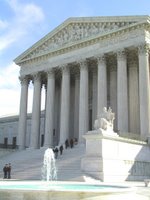
 The Supreme Court came down with a split decision on punitive damages today, avoiding a determination in a highly watched case on the issue of “How much is too much.” In doing so, however, they tossed out the verdict based on the jury instructions, since the jury was told it could base its determination on how non-litigants had also been harmed. The case was decided 5-4.
That part of the decision avoiding the issue of “excessive damages” was not unexpected, as I wrote a few months ago (US Supreme Court Hears Punitive Damages Case, Again), as the justices fretted over the jury instructions.
The Oregon case, Philip Morris v. Williams, had resulted in an $800,000 compensatory award and a $79.5M punitive award.
This case has been an extraordinary odyssey that has taken it up to the Supreme Court twice on the subject. It goes something like this:
- Jury verdict for $800,000 in compensatory damages and $79.5M in punitive damages;
- Punitive damages reduced by trial court to $32M;
- Punitive damage award reinstated by Oregon Court of Appeals;
- Affirmed by Oregon Supreme Court;
- Remanded by US Supreme Court to decide punitive damages issue in light of its new ruling in State Farm v Campbell;
- Affirmed again by Oregon Court of Appeals;
- Affirmed again by Oregon Supreme Court;
- Now vacated by U.S. Supreme Court based on the jury instructions.
Justice Breyer’s majority opinion starts with this summary:
The question we address today concerns a large state-
court punitive damages award. We are asked whether the
Constitution’s Due Process Clause permits a jury to base
that award in part upon its desire to punish the defendant
for harming persons who are not before the court (e.g.,
victims whom the parties do not represent). We hold that
such an award would amount to a taking of “property”
from the defendant without due process.
Since the jury instructions included a charge that Philip Morris could be punished for harm to non-litigants, the court never reached the ultimate issue of what constitutes “grossly excessive” punitive damages.
The problem with the majority’s view is that the “degree of reprehensibility of the defendant’s misconduct” is already before the jury on the issue of punitive damages, and that includes the dangers to others. How then, not to consider the harm to others?
The hair-splitting of the court was extraordinary in considering the issue of how to view the dangers or harm presented to non-litigants. The holding by the court came down to this: You can show potential harm to others in order to argue that the conduct is reprehensible and therefore worthy of being punished with punitive damages. But a jury can’t consider actual harm to others. I hope you followed that Clintonian parsing, because it was too much for four of the justices. Justice Stevens,wrote in dissent:
While apparently recognizing the novelty of its holding… the majority relies on a distinction between taking third-party harm into account in order to assess the reprehensibility of the defendant’s conduct — which is permitted — from doing so in order to punish the defendant “directly” — which is forbidden…This nuance eludes me….
[T]here is no reason why the measure of the appropriate punishment for engaging in a campaign of deceit in distributing a poisonous and addictive substance to thousands of cigarette smokers statewide should not include consideration of the harm to those “bystanders” as well as the harm to the individual plaintiff. The Court endorses a contrary conclusion without providing us with any reasoned justification.
Justice Ginsburg (joined by Scalia and Thomas) felt the same way on this issue, writing:
The Court thus conveys that, when punitive damages are at issue, a jury is properly instructed to consider the extent of harm suffered by others as a measure of reprehensibility, but not to mete out punishment for injuries in fact sustained by nonparties.
Thus, a judge must now tell a jury in a punitive damage case that they may consider the reprehensibility of the defendant’s conduct toward others, but not the harm to them. If four Supreme Court justices don’t understand this formula, why would a jury?
The case now goes back to the Oregon Supreme Court, perhaps to clarify its opinion on how the jury instructions were used, or perhaps for a new trial with clearer instructions (if that is possible). Unless, of course, all the litigation ultimately drives the plaintiffs’ lawyers bankrupt.
The three opinions are here:PhilipMorris.pdf
[Update: 2/23/07 — Philip Morris Punitive Damages Decision — Why It Was Good For Plaintiffs – based on the dissent of Justice Stevens and oral argument comments of Justice Breyer]