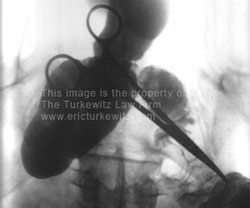
 That headline above is the title of a story currently running on CNN’s web site. It comes out of Atlanta about a patient that believes malpractice was committed on her during the course of a hysterectomy, and has necessitated three additional corrective procedures. Her allegation is that the surgeon erred by nicking a ureter, causing urine to accumulate in her abdomen. The patient, as it happens, is also a physician.
But when the doctor-patient tried to find an attorney to handle her case, she struck out. Why? Because the difficulty and expense of medical malpractice litigation results in de facto immunity for the medical profession in a great many cases. Without a catastrophic injury, it becomes very difficult when looking at the costs and benefits to undertake representation. The story is remarkably similar to one I wrote about the other day, about a California doctor seeking out a medical malpractice attorney (see: Another Tort “Reformer” Sees The Light).
The two stories point to a brutal reality of medical malpractice litigation and the contingency fee system. As a business model, it sucks. Big time. An attorney must lay out many thousands of dollars for years on end, while still paying the overhead of an office (not to mention the mortgage, car, kids, etc.) for a risky endeavor. Perhaps many such risky endeavors. Calling this a significant cash flow problem is an understatement. Then, if the case is won or settled favorably, you have to listen to people who are ignorant of the economic realities pretend that the legal fee is some kind of easily made gravy. One thing is for sure, it is not the road to any kind of economic security. I wrote about this months ago in Medical Malpractice Economics.
And so, the lawyers that get the inquiry of the type you see in this CNN story are faced with the same kind of decision those of us in the profession deal with every day. Turning away inquiries at a rate, if their experience is like mine, of probably 95-98%. Most won’t make it past the telephone interview, and if they do, past the office interview. I wrote about the mechanics of vetting the medical malpractice case back in May.
So these stories make headlines every so often. But for those that deal with this stuff, they come as no surprise at all.
The other day Susan Cartier Liebel made a request for stories about starting up your own practice, in a type of Letter to A New Lawyer. So here’s my advice. Think twice about any field where you spend your own money for years on end for a future result with no current cash flow. Line up your financial resources in advance. Start a line of credit with a bank now. Don’t wait for the time when you actually need it. Banks only want to lend money to people who already have money, not to those that are cash-strapped.
And I’m willing to bet that not a word of this was taught in your law school.
Pingback: My Letter To A New Lawyer (Circa 2008) | Build A Solo Practice @ SPU