 If the high court takes this case, an interesting question is posed: Can participating in a fantasy baseball league require Unites States Supreme Court judges to recuse themselves? In particular, will Justices Samuel Alito or John Paul Stevens find themselves watching this suit from the sidelines if it goes up to the high court?
Stock investment, we know from the recently decided 4-4 decision in the Rezulin drug case (Warner-Lambert v. Kent), can cause a conflict of interest recusal, as Chief Justice John Roberts didn’t participate due to a $15,000 stock investment in Pfizer, parent company of Warner-Lambert. The subjects of recusal and the problems of a 4-4 split have been discussed by many, including Howard Bashman (advocating an appellate judge sit by designation), Drug and Device (the problem of forum shopping due to splits in the Circuits, and its impact on multi-district litigation), and SCOTUSblog (noting that this is a rare occurrence). It had previously been discussed by Eugene Volokh (sell your stock judge!) and Stephen Bainbridge.
That recusal may now come up again, not due to stock holdings, but quite oddly in an altogether different manner: The subject of Rotisserie Baseball (a/k/a “roto” or fantasy baseball) is now before the court on a petition for certiori to determine if baseball statistics are owned by Major League Baseball or are free to the world under the First Amendment (see Above the Law, Sports and the Law: Supreme Court Might Hear Dispute Over Fantasy Sports Property Rights, CBC v. Major League Baseball).
Here’s how it impacts players of the game, which could easily include one on or more high court judges: Fantasy team owners draft real players from around the league at the start of the season to form their own teams in their own leagues, and use those very real statistics as their own to compete and trade against other team owners in their fantasy league. But it’s not just a few bucks in gambling money at stake for the winner. Those statistics are complied by various services that make them available to the public for a fee. So even if you aren’t in a roto money league, you still need the stat service to compile the data to determine which fantasy team has more homers, RBIs, stolen bases, etc. than the other teams in your league. And Major League Baseball wants a cut of that money by licensing the information out.
If you play roto you know this drill well. Now heading into my 20th season, I haven’t yet won, despite the heroic efforts of my brother that does 99% of the heavy lifting. But if you have to pay more money at the beginning of the season for the right to use those stats then there will be real economic issues for every single team owner. We fantasy team owners don’t want to pay money to the multi-millionaire real team owners just to have our fun.
Setting up dates for the start-of-the-year drafts are going on now across America as the season prepares to open. These fantasy leagues are very popular, with a considerable industry devoted to it (hence the litigation). So this leads us to this oddball question with its constitutional issues: Are any of the Supremes fantasy team owners? If so, they have an interest in the outcome of the suit. What does that lead us to?
Free league or not? Does fair use of the statistics come into play if the league is non-money, meaning no gambling fees, but you still need to pay for the stats? Will free leagues still be required to pay a fee for use of the stats if the court were to decide that Major League Baseball owned them or does the First Amendment protect them? Is it different for leagues with money involved?
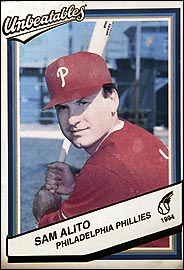 Oh, I know what you think, this a silly long shot. But read this from US News and World Report on Justice Samuel Alito:
“A longtime Philadelphia Phillies fan, he uses sports metaphors in speeches. As a child, he played second base and dreamed of becoming a baseball commissioner. As an adult, he coached his son’s Essex County Little League team, and his wife once sent him to a fantasy Phillies baseball camp where he played second base alongside professional ballplayers.”
Reviewing a photograph of the chambers of Justice John Paul Stevens, I see a signed Cal Ripkin baseball, a picture of The Babe and a 1932 Word Series scorecard. You gotta be a pretty big fan to have a framed scorecard in your chambers.
Roto in the high court? Seems like a possibility.
Either Alito or Stevens (or others) might have to consider recusal since they may be forced to pay money to buy the stats if the case is decided in favor of Major League Baseball.
As ballplayers limber up in Florida and Arizona for the coming season, the issue of money hangs over the heads of fans who play fantasy baseball. Or at least, it will hang over their heads if the Supremes take the matter and render an unfavorable decision.
Last: The petition for certiori, now pending, may tell the tale of whether one or more recusals are in the works.