 The U.S. Supreme Court granted certiorari today in the “Fantasy Baseball” case of CBC Distribution v. Major League Baseball Advanced Media. The suit is remarkable not only for the First Amendment and right to publicity issues that form the basis of the dispute, but because Justices John Paul Stevens, Samuel Alito and Stephen Breyer recused themselves due to their participation in a fantasy baseball league comprised of current and past court personnel. Justices Antonin Scalia and Ruth Bader Ginsburg, who also participate in the league, declined to disqualify themselves, exposing a non-ideological split in the court on the issue of when justices should step aside when conflicts appear.
Coming up from the Eighth Circuit Court of Appeals, the suit revolves around the use of real statistics generated by players at the major league level for use in fantasy leagues (also known as “Rotisserie” baseball). These rotisserie leagues, generally comprised of 10-12 teams, draft players from major league rosters at the start of the year and then use actual statistics to determine their fantasy league standings. Teams pay fees at the start of the season for a stat service to compile those standings, with additional money usually contributed to create a pool for the winner.
The litigation arose because the growing popularity of the leagues created a huge industry of services to compute those stats to determine placements. According to the Fantasy Sports Trade Association, 19.4 million people are now actively playing in a fantasy sport league in the U.S. and Canada, with total revenues of $2 billion last year, and it has spread overseas. CBS Sports, ESPN and Yahoo are among some of the giant companies that have built extensions of their core business to profit from the fantasy leagues.
Major League Baseball has been trying to grab a piece of that action, which they see as their own, wanting to license out the names and statistics of the players. MLB claimed a violation of the right to publicity by the various services. Plaintiff CBC Marketing, by contrast, argued that the information is in the public domain and that they have a right under the First Amendment to use it for their statistics service. The Eighth Circuit held that the First Amendment trumped baseballs’ right to publicity, and MLB petitioned the high court for a hearing. The issues have prompted countless articles and blog postings (some linked below) and law review articles at Harvard (via Concurring Opinions) and Ohio State.
The disqualifications of the three justices come from some of the court’s biggest baseball fans, who are involved in the Supreme Court’s own fantasy league (more below). If they were to vote against Major League Baseball in the suit they would be deciding in favor of their own economic interests. Depriving the court of its stalwart fans can’t be a good thing for the fantasy players. As it happens, I speculated just two weeks ago that one or two justices might run into this problem: Recusal In the High Court…For Fantasy Baseball? The court is now deprived of a full 9-person team to field the case. (Sorry, had to say that. It’s my blog and I get to write that sort of thing.)
According to the controlling statute, 28 U.S.C. 455, the justices should step aside if they have a personal bias concerning anyone in the case, or independent knowledge of the facts in dispute; if they worked on the case as a private or government lawyer; or if they or close relatives have a financial interest in the case. The issue of recusal has been a hot topic in the legal blogosphere (see, Bashman, Volokh, Bainbridge, SCOTUSblog), where it most often appears in the context of stock ownership. This is the first time in the modern era that three justices at the high court have recused themselves in the same case, where six justice represent a quorum.
Each of the recusals (and the non-recusals) come with a history:
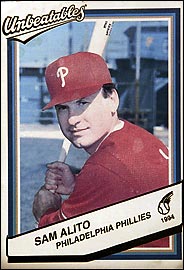 Justice Alito — a huge Phillies fan and a former participant in a fantasy baseball camp — had been embarrassed back in 2005 when he was still on the Third Circuit bench and wrote a decision involving mutual fund company Vanguard. The problem was that he also had investments in the company but had failed to disclose it. After his financial position became known he belatedly disqualified himself and the case went back to the court for reconsideration. Having been burned before he was apparently taking no chances today. Justice Breyer (who was honored at Fenway Park in 2006) shares ownership duties with Alito and likewise removed himself from the case.
Their recusal under the ethics law, 28 U.S.C. 455(b)(4) comes because a justice “shall” disqualify himself if he has “a financial interest in the subject matter in controversy …” While the cost of a stat service for a league isn’t much, the statute does not have a minimum financial standard and seems to speak in absolute terms with use of the words “shall” and “a financial interest.”
Justice Stevens — who has in his chambers a framed 1932 Yankees-Cubs World Series scorecard, a game he may have attended as a 12 year old growing up in Chicago, as well as an autographed Cal Ripkin baseball — cited one of his past decisions and a different section of 28 U.S.C. 455 in stepping aside. Having previously analyzed section (a) of the judicial ethics law dealing with the appearance of partiality, he wrote in 1988 in Liljeberg v. Health Services Acquisition Corp that “the very purpose of [this law] is to promote confidence in the judiciary by avoiding even the appearance of impropriety whenever possible.” Since his participation here could give that appearance due to his interest in the league, even if minimal, he likewise removed himself from the case.
Neither Justice Scalia or his teammate Justice Ginsburg — who came of age in Brooklyn during the late 40s and 50s of the storied Dodgers, and who wrote the court’s opinion in U.S. v. Cleveland Indians — will step aside, however, despite their participation in the league and the law’s straightforward language. Scalia had famously failed to to recuse himself in a 2004 case involving his friend and hunting partner Vice President Dick Cheney. He wrote, “If it is reasonable to think that a Supreme Court Justice can be bought so cheap, the Nation is in deeper trouble than I had imagined.”
The Supreme Court justices make their recusal decisions without judicial review, thereby giving each one wide discretion on whether or not to step aside. The non-ideological split in the court over the ethics law exposes the somewhat arbitrary standards that the justices use in identical personal circumstances and how it results in different outcomes. Testifying before the Senate two years ago on the issue, American University law professor Amanda Frost said of the “ad hoc, opaque, and unchecked quality” manner that these decisions were made:
This procedural vacuum has, I believe, been the cause for recurring controversies over judges’ failure to recuse — controversies that undermine the very goal of section 455 to protect the integrity of the judicial branch.
Background on the recusals came to me from a former law school classmate and avid fantasy baseball player who formally worked at the court, after reading my speculation two weeks ago on the issue. While obviously not wanting to be identified here, s/he told me of a trip to Florida two weeks back for an annual spring training vacation with friends and to watch a cousin, Siddhartha Finch, at the New York Mets’ spring camp in Port St. Lucie. Over twenty years ago Finch gave up a promising baseball opportunity to pursue a career with the French horn. He is trying to become the first rookie over the age of 50 to break into the big league as part of a book project. My friend also bumped into Monica Bay, who was likewise making annual rounds of the spring camps.
Finch, I was told, was then picked up this past weekend by the Alito/Breyer team at their annual draft. He was added to their reserve roster in the event of an injury to a player on the main roster. (Finch will be starting the year at the Mets’ Double-A affiliate in Binghamton.)
In addition to the five justices, there are players from among past and current clerks, marshals and others on the court’s support staff, with many of the teams sporting multiple owners in order to share the considerable amount of research that goes in to competing. Other gossip from the high court league, which comes from rotisserie forums and listserves that I participate in:
- The high court league has been around for years, and is known as Articles For Deletion, based on an old spoof about amending substantial parts of the Constitution to increase the court’s power. When the league was named, there was a vote between AFD and Least Dangerous League (a spin on Alexander Hamilton’s comment about the judiciary being the “least dangerous branch” of government). AFD won after the ten original fantasy teams deadlocked and the tie was broken with a coin toss held in the court’s conference room.
- The passionate interest in baseball at the court led the Supreme Court website Oyez.org to compare each justice to a different player at the end of their respective biographies. For example, John Jay, the first Chief Justice, is compared with Kenesaw Mountain Landis, the first commissioner of baseball, and Thurgood Marshall with Emmet Ashford, the first black umpire. You can test your baseball/Supreme Court knowledge at the site with any justice you want.
- Stevens, teamed with retired administrative clerk Ernie Thayer, drafted the much despised Jimmy Blake. This prompted a good deal of abuse about a judge drafting a player with legal problems, and the “what if” factor if the case ever came before the court.
- Scalia and Ginsburg’s team also includes a federal marshal and is called “The Three Sopranos,” merging their tastes for opera and an HBO show.
Major League Baseball is represented by Sidley Austin. It’s petition for certiori can be found here. Oral argument could potentially be scheduled during the World Series this October.
(Full Disclosure: I’m entering my 19th year in one of these leagues. My brother, and co-owner of The Turkeys, was working on draft preparation two weeks back while sitting jury duty. He described our two year plan to a USA Today columnist last year in these two pieces. Our draft was held Saturday. We expect to win it all. But since we’ve never won, and last year we came in last, don’t even think of e-mailing us for advice.)
And so the question remains: Should the justices recuse themselves (Stevens/Alito/Breyer) for this type of connection to a case or not (Scalia/Ginsburg)?
More on the underlying suit can be found at these blogs:
-
- More than a Game: Fantasy Sports Industry Wins Recent Legal Battle Over Use of Player Stats (Intellectual Property Media and Entertainment Law Blog)
- CBC v. Major League Baseball (Patent Arcade)
- Fantasy Baseball 2, Real Baseball Zero (Owners, Borrowers and Thieves, an IP blog)
- Eighth Circuit Rules Against MLB In Fantasy Baseball Suit (Neil Richards @ Concurring Opinions)
- Sports and the Law: Supreme Court Might Hear Dispute Over Fantasy Sports Property Rights (Marc Edelman @ Above the Law)
- Fantasy Sports League Hits It Out Of The Park In Challenging MLB’s Ownership Of Player Statistics (The IP Law Blog)
- Fantasy League Wins Ruling; Judge’s decision that baseball statistics are in public domain could have far-reaching effects (How Appealing – round-up of news stories)
- Fantasy Stats Case: Could be Heard By U.S. Supreme Court (The Biz of Baseball)
- The Ledger Domain, The Impact of the Fantasy Stats Ruling (Baseball Prospectus)
- Does Fantasy Baseball Violate Copyright? (Tech Law Advisor)
- Fantasy Baseball (Patry Copyright Blog)
———————————
Update: A number of blogs have taken note of the breaking story, and comments are plentiful. This will be updated again as the story develops:
- Who Owns WHIP? We May Find Out Soon (DeadSpin)
- Supreme Court granted certiorari today in the “Fantasy Baseball” case of CBC Distribution (Baseball Think Factory)
- SUPREME COURT GRANTS CERT IN ‘FANTASY BASEBALL’ CASE (Volokh)
- Morning Docket (Above the Law)
- New York Magazine (part of Daily Intel round-up and update)
- Supreme Court Fantasy Baseball League (Stubborn Facts)
- Certiorari in Fantasy Baseball Case (PrawfsBlog – post has now been taken down)
- Simple Justice (Scott Greenfield)
- More than half the U.S. Supreme Court living a fantasy life? (San Diego Tribune)
- Cert in Fantasy Baseball Case (SportsLaw – post taken down)
- Fantasy Baseball Before A Short-Rostered Supreme Court (Not a Potted Plant)
- Supreme Court Hears Fantasy (The Dude Abides)
- Reports of Supreme Court Fantasy Baseball Case … (ABAJournal)
- Even the Supremes Live a Fantasy Life (Missing J.T. Snow)
- Fantasy Baseball at the High Court (Dartblog)
That is a great prank. quite brilliant. Bravo 🙂
Pingback: April Fool’s Day is Here (Sorry, No Joke Today) – New York Personal Injury Law Blog
Funny thing that some of the Justices inhibit themselves from the case because they are joining or had joined Fantasy Baseball. But with the advent of information technology i believe that more and more cases like this will come up in the future. Some could be even weird cases not tackled before in any court. I mean cases involving the cyber culture.
Leonard B.
Writer and Blogger