When medical care costs go up, tort “reformers” love to scream “defensive medicine” and blame medical malpractice attorneys for the rising costs. All those unnecessary tests, they rationalize, must be due to the doctors’ fear of being sued.
Except, of course that there are other reasons for unnecessary tests. Like greed. Because doctors and hospitals, for example, gets paid more money for more surgeries. Expensive surgeries.
And so comes this story in the Wall Street Journal (Doing a Volume Business in Liver Transplants), not exactly a friend to consumer groups, about the University of Pittsburgh Medical Center and the way they increased their liver transplant business. They had once been leader in the field, lost it, and sought to reclaim it by hiring Amadeo Marcos, a transplant surgeon who promised to double the number of liver transplants the hospital did.
And he did do that. But it came at a price. In order to get all those transplants done, they had to change the rules about which patients get them and where the livers come from. From the WSJ article:
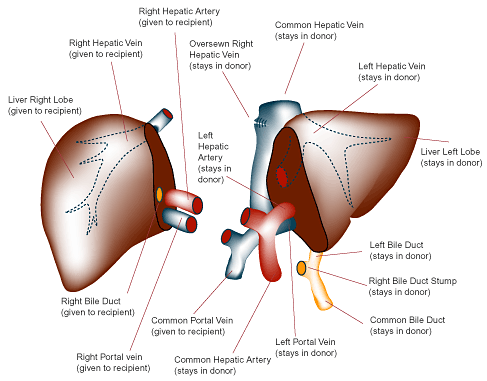
To overcome a perennial shortage of organs, he used more livers from older donors. He transplanted some of these into relatively healthy patients for whom the risk-reward calculation was less certain. He used partial livers from living donors, and then understated complications from the controversial procedure.
It’s worth noting here that, while the hospital is ostensibly a non-profit and therefore evades most taxes, it’s mucky-mucks don’t treat themselves that way:
Its chief executive, Jeffrey Romoff, earned $4 million in the fiscal year ended June 30, 2007, and 13 other employees earned in the roughly $1 million to $2 million range. For their transportation, UPMC leases a corporate jet. Earlier this year, UPMC relocated its headquarters into Pittsburgh’s tallest skyscraper, the 62-story U.S. Steel Tower.
How much is a transplant? About $400,000-$500,000. There’s a lot of money is those livers, if one only knows how to mine them.
According to two doctors that worked with Dr. Marcos:
Dr. Marcos put some of these organs into patients who were in the early stages of liver disease, say Dr. Fung and Howard Doyle, who then worked in UPMC’s transplant intensive-care unit. These were patients, they say, who sometimes didn’t need a transplant.
“For the first time in years, we had people dying on the operating table or in the ICU,” says Dr. Doyle, now director of surgical critical care at Montefiore Medical Center in New York. At times, according to him, patients healthy enough to walk into the hospital before being transplanted died “because they had a high-risk liver put into them.”
Next week, or perhaps the week after, there will be yet another report, someplace, somewhere, about the high cost of medicine, and someone will scream “blame the lawyers” and this story will be forgotten.
————————————-
Hat tip to Kevin, M.D. (“This is revenue-driven medicine at its extreme”).
Another synopsis (if you don’t get WSJ) by Buckeye Surgeon Dr. Jeffrey Parks at Transplants Run Wild. He has this nugget, but the whole post is worth reading:
Well, it became evident that Dr Marcos was putting bad livers in patients who weren’t that sick. Let’s say your patient is number 25 on the MELD list. A liver becomes available. But it’s a bad liver (old patient, prolonged ischemic insult prior to harvest, steatotic, etc) and transplant surgeons representing patients 1-24 on the list have all turned it down. It’s a terrible liver, they say. Odds are, it won’t work all that well. Your patient isn’t that sick. In fact, said patient is living independently at home and was buying groceries for her family when you called her to tell her a liver was available. Nevertheless, you book her for the OR that night and stick that liver in her anyway.
Pingback: John Stossel, Hypocrisy Again – New York Personal Injury Law Blog
Pingback: John Stossel, Hypocrisy Again – New York Personal Injury Law Blog