New York Personal Injury Law Blog: How One Brooklyn Courtroom Wastes $10M Each Year

Eric Turkewitz, The Turkewitz Law Firm, New York, NY  

Wednesday, November 19, 2008


How One Brooklyn Courtroom Wastes $10M Each Year

This is a story of how one courtroom in Brooklyn is responsible for wasting over $10 million in legal time. Every year. And that calculation is conservative.

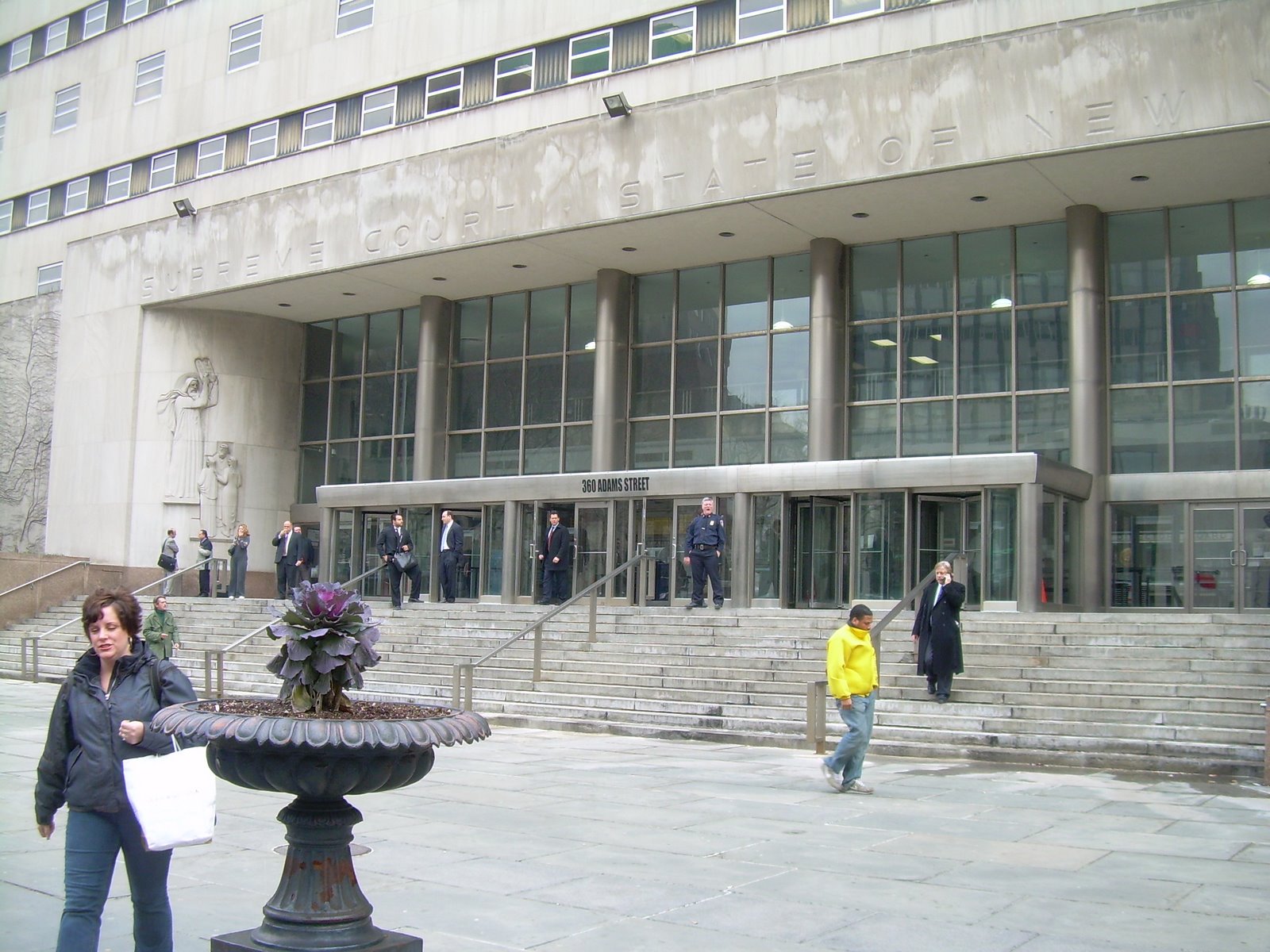
The scene for this nightmare is one of our local trial courts, the Supreme Court Building in Brooklyn. The courtroom is called the Central Compliance Part, or CCP as it is known to its denizens. And each day in this massive ceremonial room, a couple hundred hours of lawyers' time is wasted. When this is annualized, the numbers are truly frightening.

To understand this misery, a little background is in order. All civil litigation starts, after the filing of complaints and answers, in an "Intake Part" where a preliminary conference is held and a discovery schedule is worked out. At that preliminary conference a compliance conference date is also set to mop up any outstanding issues. If your adversary decides to show up on time you could be done in a half hour.

But when you return for that compliance conference, you will not leave in a half hour. No way. The calendar will have over 100 conferences and motions on it. Over the course of a morning some 200 lawyers can easily come and go through this model of epic legal inefficiency. Today's calendar, for example, had 75 conferences. It looked like this: /ConferencesCCP.pdf
Now add to that the motion calendar with 72 motions and cross-motions involving 54 different cases, which looks like this: /MotionsCCP.pdf

Now ask all the lawyers to show up at 9:30, in one place.

Even if you can work out any remaining issues with your adversary, and you can accomplish what you need in 10 minutes, which is often the case, you may not leave this room for two to three hours. Even if you work everything out and submit a proposed order with no issues that need judicial intervention, you might still wait for an hour for a signed order to be returned to you. And this waste doesn't count the time going to and from court.

The system is so bad that a cottage industry of "per diem" lawyers has even grown up around it. These folks will, for about a hundred bucks, take care of your conference or routine motion. They make their living by running around from courtroom to courtroom on behalf of others who have conflicts, or who can't spare half a day to do 10 minutes of work. While this may be seen as a boon to some who want to go this route, it also means that if you are on the other side of a per diem who has booked several different things in different courtrooms, you may be left cooling your heels waiting, and waiting and waiting, while they make their living elsewhere and waste your time.

This is no way to run a courthouse. The lawyers all know it. The judges all know it. The clerks all know it. Everyone hates it. Except for the per diem lawyers running around the courthouse putting their band aides on a septic system.

Having now ranted a bit, let me add my suggestions for fixing this very broken system that is wasting hundreds of hours of legal time every day on matters of simple discovery.

First: The court must create an electronic template for their compliance orders that the attorneys can use, with required dates for completion and a future conference. That is the easy part;

Second: Every Preliminary Conference should have a provision whereby the attorneys are required to have a conference call at least 20 days before the compliance conference so that they can use that template to create a stipulated order to complete outstanding discovery;

Third: All completed orders can be submitted via email to the court, with blanks left for future court dates and a place for the attorneys to note their availability or unavailability due to conflicts. The court then prints, signs, and files and the lawyers retrieve the order via eLaw.

Fourth: Any unresolved issues must be subject to a court conference call with one of the court attorneys. Scheduling is done by email with a specific time to call in;

Fifth: In the event of a real issue that has defied resolution, or an unreasonable or obstreperous lawyer is involved, a court conference is scheduled;

Sixth: Some lawyers don't, ahem, get paid to move cases efficiently. They get paid to be unreasonable. Wasted time means more billable hours. The court has to start treating the directives in preliminary conference orders more seriously and be stricter with problematic firms as the judges do in the federal system. This will ultimately force lawyers to work things out, or risk the wrath of the court for being unreasonable or routinely ignoring orders.

The system is broken. Badly. It needs to be fixed.

And so, to the Powers That Be in Brooklyn, I beg and beseech you. Fix it. Just 200 hours of wasted time a day -- and it is really much more than that -- is 1,000 hours a week, which is over 50,000 hours per year. At $200/hour that is $10,000,000/year.

Out of just one courtroom.

Labels: ,


Comments:
Eric-You make an excellent point. But until defense law firms stop billing their insurance company clients on an hourly basis, the broken system will keep on chugging along. From personal experience, I can tell you that the pressures to log in unrealistically high amounts of billable hours make any defense lawyer seize on any opportunity to go to court, and the further away from the office the better, since the travel time is often included as billable time. Without such court appearances, most defense lawyers would be unable to amass the minimal number of hours they need to stay employed, and rise up within the firm. While some insurance companies have experimented with paying their law firms on a "flat-fee" basis, this idea has not sparked any revolutions in the way defense lawyers are paid. Most are still doing the billable hour thing, despite the constant fights that occur when the insurance companies question any time entry they find suspiciously large--and they find almost everything suspiciosly large. Naturally, this wastes even more time, only now it is that of the defense firm, which is spending so much time and energy defending its billing to the insurance company that it neglects defending the real clients (doctors, hospitals, businesses).
The flat-fee structure has potential. Unfortunately, it has developed a negative reputation because the law firms have traditionally ended up on the short side of the bargain, and needing to do more work then they will be paid for.
 
Thank you for bringing up this important issue! I can't even begin to tabulate all of the hours that I have wasted in CCP!

Further, most of the cases that are dealt with there are slip-and-falls and auto cases, and so the part is not equipped for and does not have the time to deal with complex discovery matters. If you end up needing to see a judge to resolve your dispute, plan on waiting through lunchtime.

Something needs to be done.

Of course, if judges enforced court orders, a lot of the nonsense which causes many of us to have to go to court would be eliminated. Since they generally do not, many attorneys choose not to follow them and are rewarded by getting to go to court for which they can bill their client (a fact acknowledged in a prior comment).

Eric Dinnocenzo
whatlawyersdo.com
 
This post has been removed by the author.
 
I have a motion on their next week. The court attorney will ask me to withdraw it (motion to strike for failing to provide discovery) and I will say no.

Nothing will happen except that I will waste 2-3 hours of my time.
 
All of this doesn't even begin to address the fact that it is impossible to get any actual disputes resolved in the CCP. I have had numerous occasions where I made 3 or more motions to compel discovery or have answers stricken all in the same case. Each time, I run into the same problem. Even with multiple Court Orders ignored, the CCP judges will not strike answers or even give a conditional order (to provide the documents by x date or have the defendants' answer stricken). Since it is not the CCP Judge's case, it is as though they do not want to make any significant decisions on the matter. The result is that I often have to just give up. Any discovery motion ends in CCP, and there is no way of breaking the cycle.
 
At bottom, CCP is a disaster because it is a completely unjustifiable departure from IAS.

Aside from all its other benefits, IAS lets judges feel the pain of delay by making them sit through unwieldy calendars. Without that, where's the incentive to accomplish anything?
 
My deepest sympathies as to your tribulations in the CCP.

The reality of the situation is that Kings County serves a very large population with a high personal injury practice, commercial motions, mortgage foreclosures, declaratory actions to name but a few of the many ways we choose to sue each other. We also have a fair amount of hotheaded people who sue out of spite or mental instability beyond your litigation in one of the most populated places per square inch. The county continually gains and loses hundreds of people a day moving in and out of it.

If I have a dispute with another party, I can threaten them with litigation. I can purchase an index number, file a summons and complaint and serve the party. I can also commence discovery. I can do all of those things without court intervention. It's only when a party becomes obstinate, or the case proceeds to trial that a Request for Judicial Intervention is filed. Once the RJI is purchased, Standards and Goals are started, to keep cases moving. This is to prevent cases from getting stale and clogging up the courts. That was the big issue when we were back in high school, we were talking about the court system getting clogged up.


Forcing all of those attorneys to CCP to conference the court, the cases are indeed kept moving, and not being allowed to languish in the back of the cabinet, as they tend to do.

We already have an opportunity to conference among counsel before the conference. In my daily routine I use a device called the telephone, and I often use it to communicate with the other attorneys representing the parties in actions where my firm appears. Many times, my calls are not returned. I do not take it personally.Why? Because I know for a fact that I will have an opportunity to speak with counsel at CCP.

This is the joy of Central Compliance. You are going to be communicating with an attorney, not a paralegal or a secretary, but someone with a law license who is authorized to enter into agreements such as stips or settlements. Many attorneys use their support staff as a rock to hide behind. The honor system does not work well.

Your e-filing suggestion is not particularly appealing. First of all, it completely excludes pro se defendants. Getting beyond that enormous problem is still difficult. After hundreds of appearances I have heard many inarticulate attorneys unable to communicate in a rational matter while having a face to face conversation with them. To think that the situation would improve electronically is absurd. It would be impossible to reduce all of the inane, convoluted, subtle or even good cause reasons into a simple electronic field and transmit it to the court. You would then reduce the practice of law to have everyone's paralegal and secretary fill out electronic disclosures while you spent all day surfing the web or golfing.

I believe the Unified Court System would take a dim view towards a broad license like e-conferencing or any such foot-dragging. for under the present system, any attempts foot-dragging must be attempted by an attorney, in person, with a guy in a black robe within running distance. A court attorney needs to see someone - anyone - who has a law license and look them in the eye to make sure the case is moving forward. Your posting doesn't appreciate that lowering those standards would really slow cases down.

It is true that there is a high volume of cases but all the cases get heard. There are also many traffic tickets heard at the DMV Adjudication Center. That has to do with the numbers of cars on the road. All the traffic tickets get heard as well. Housing Court, Civil Court, Small Claims Court, its all high volume. The town of Neversink is located in the middle of the reservoirs in the Catskills. The volume is very low. I have waited there as well. It takes time for people to drive in the snow. And the world continues turning and photosynthesis continues unabated.

The post is essentially railing against the bureaucracy in the name of efficiency. The truth of the matter is that what you try to do as an attorney is to get to a courtroom early, having eaten, having gone to the bathroom, having something to read with a clear calendar, and having your adversary as prepared and as ready as you. That happens a very small part of the time. Someone is late. Someone is on vacation. A party is sick. A witness is out of the country. You have an Order to Show Cause on at the same time in another court part. This is what we call in the profession as the "practice of law".

There is the occasional indignity of having to wait for a couple of hours, but that only burns the counsel whose fees is recovered on contingency. Litigants such as insurance companies have a vested interest to investigate and dispute claims brought against them. CCP provides that transparency.

I am curiously intrigued by your negative characterization of per diem attorneys. It seems to display a fundamental lack of understanding as their humanity or professionalism. I have met many of them, and all of them were very reliable, intelligent and fiercely independent professionals. Perhaps it is their eccentricities or personalities which struck some strange chord in your post but they play an invaluable role in keeping litigation moving with a professional standard. Without them, the courts would be overrun with paralegals and other people performing the unauthorized practice of law.

Per diems do everything from obtaining adjournments to conducting trials. There skill levels rival experienced litigators. My per diem colleagues who I met as adversaries I often later retained on my own cases since they were a pleasure to work with rather than some buttoned up associate at a white shoe stammering about the CPLR. They gave me valuable piece of mind on my summer vacation to Maine and my trip to Italy last February.

However, in my normal practice I don't use per diems because as attorneys, all we do is try to predict what a bureaucrat will do. Which means, to be a good attorney, you need to be where the bureaucrats are, you need to be in the bureaucracy, to glide through the marbled halls along the benches where the low and high have sat, to smile and shake the hands of your colleagues as you endeavor in good faith to negotiate a fair and reasonable outcome for your client. We cannot feel the pulse of the judge, watch the stroke of the pen of the legislature or hear the crack of the gavel from our webcams or golf courses any more than our dentists and surgeons could scrape away at our delicate parts through telecommuting. Our profession is a noble one, not an easy one. Nor is the tasks set upon by the court clerks who work in CCP who are not attorneys and work for an extremely modest wage and are forced to deal with impatient and incoherent attorneys who denigrate and sneer at their attempts to conform to the many rules they must follow, then they come home to read a post about their courtroom wasting ten million dollars.

The wheels of justice may turn slowly, but they do indeed turn. They turn slowly to make sure that no one is crushed underneath them.
 
I am curiously intrigued by your negative characterization of per diem attorneys.

Actually, I was only referring to those that over-schedule and keep everyone else waiting. I started my own practice by doing per diem appearances. So my apologies if that came out wrong, but it was not intended as a slam against all.
 
CCP is not so bad because you can time things so you don't lose so much time there. What is a waste of time is the Commercial Part. Just spent three and a half wasted hours there, including an obnoxious, mean decision on oral arguement. CCP cannot match that (close as it might come).
 
Post a Comment


Links to this post:

Create a Link


<< Home


The New York Personal Injury Law Blog is sponsored by its creator, Eric Turkewitz of The Turkewitz Law Firm. The blog might be considered a form of attorney advertising in accordance with New York rules going into effect February 1, 2007 (22 NYCRR 1200.1, et. seq.) As of July 14, 2008, Law.com became an advertiser, as you can see in the sidebar. Law.com does not control the editorial content of the blog in any way.

Throughout the blog as it develops, you may see examples of cases we have handled, or cases from others, that are used for illustrative purposes. Since all cases are different, and legal authority may change from year to year, it is important to remember that prior results in any particular case do not guarantee or predict similar outcomes with respect to any future matter, including yours, in which any lawyer or law firm may be retained.

Some of the commentary may be become outdated. Some might be a minority opinion, or simply wrong. No reader should consider this site (or any other) to be authoritative, and if a legal issue is presented, the reader should contact an attorney of his or her own choosing for advice.

Finally, we are not responsible for the comments of others that may be added to this site.


This page is powered by Blogger. Isn't yours?