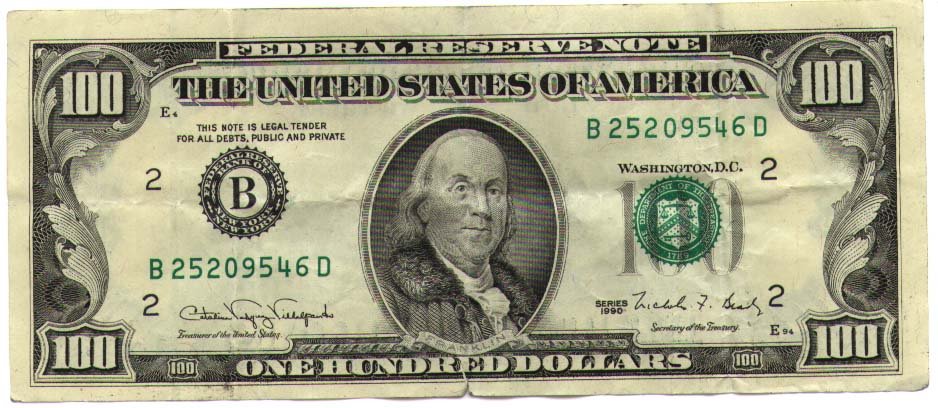
 This is two stories in one. First, a Target store down in South Carolina falsely accused a woman of using a counterfeit $100 bill. She sued Target and won $100K in compensatory damages and Target was hit by the jury with $3M in punitive damages. Then Ted Frank at Overlawyered decided this would be a good fit for that site, but the facts he used didn’t seem to fit the story. If you want to see how some lawsuits get turned into urban legends, this might be a good example to follow.
First the suit, which comes via Turley, citing a local news story:
Rita Cantrell of Greer went to two Target stores in the Greenville area in Feb. 2006, and both times employees accused her of using a counterfeit bill. Cantrell tried to buy items at the store and pay with an older series $100 bill.
[A Target] store employee sent out an e-mail to dozens of other retailers and law enforcement agencies warning them that Cantrell was a shoplifter who tried to spend bogus cash. The e-mail also included Cantrell’s picture.
According to Target’s own brief in their failed motion for summary judgment, Ms. Cantrell visited a Target store (just one store, not two as in the news story above) where a counterfeit was suspected. They declined to take the money when offered and asked her if she had another form of payment. She shook her head no, took the goods out of her basket, and walked out of the store. Then came the accusatory email.
The problems were that the bill was legit, and the email also went to her place of employment. And Target didn’t identify the money as a “possible” counterfeit. No sirree. The email said “The lady pictured attempted to use a counterfeit 100 dollar bill today.” So the accusation was unambiguous. (See Order denying judgment.)
The Secret Service was called in, verified the money as real, and Target was sued for the embarrassment and humiliation that Ms. Cantrell suffered, with the jury ordering 100K in compensatory damages and $3M in punitives.
From the original article came this response: Target spokeswoman Bethany Zucco said Friday the company will challenge the ruling.
“We are extremely disappointed by the magnitude of the compensatory and punitive damages awarded by the jury in this case,” Zucco said in a statement. “We sincerely regret any inconvenience incurred by the plaintiff.
Scott Greenfield wrote about this case the other day ($3M to the Target of Target) and remarked about this pathetic response:
Any inconvenience? You sent out a mass email, with her picture, telling the world that she’s a thief and forger, and you’re sorry for the inconvenience? There’s an “apology” that demands some serious puni’s alone.
And now comes the urban legend part. Ted Frank, a well known tort “reformer” at Overlawyered jumps into the action (Cantrell v. Target: $200 medical bill = $3.1M verdict). Except some of the facts in his post look a little different from the Target brief and the judge’s opinion.
1. As noted above, Target clearly identified the money as counterfeit, writing in the email, “The lady pictured attempted to use a counterfeit 100 dollar bill today.” But not according to Frank. In his version of the story, the central accusation is watered down to this:
Target employees were foolish in being unable to recognize the old currency, and mistakenly identified it as a possible counterfeit.
Now that, my friends, is just flat out wrong. They did not use any qualifying language about this being a “possible” counterfeit. That’s why there was a lawsuit and a jury verdict. Because the language was not qualified the way Frank wrote it. Hopefully Frank will fix this before his new version of the story becomes an urban legend.
2. Next up: When the incident happened, Ms. Cantrell “shook her head no and walked out of the store” in response to Target’s query of whether or not she had any other way to pay for the merchandise — as described in Target’s own brief to the court. But Frank says she “fled.” That’s right. Instead of an angry or anguished person simply walking away without the goods they came for after indicating they had no other funds to pay with, he claims she “fled” the scene. Now that’s just wrong (defamatory?).
Hopefully Frank will fix this too before his new version of the story becomes an urban legend. (I’m not being snarky, by the way. We all make errors and he has fixed his in the past.)
3. Next up, the Frank headline refers to a $200 bill and says that is no reason for a big award. Apparently, mental anguish and humiliation are not compensable under Frank’s view. We know this because he calls her experience merely an “inconvenience'” though there is no evidence in Frank’s piece to suggest he actually heard any of the testimony of what she went through. And when I challenged him in the comments to his post, he responded by writing that “the plaintiff suffered no actual injury.” Obviously the people who actually heard the evidence feel otherwise. When people who haven’t heard the evidence make such comments about those who have, it would be appropriate to immediately question the objectivity of that critic and question how their political leanings have affected their view of the facts.
If is fine, of course, for Frank to have a strong opinion and political leanings and write about them — only a fool would question his rights to criticize — but that should not lead to changing the facts of a case.
Frank brings up medical costs and their relationship to injuries in order to minimize Ms. Cantrell’s experience, and it is true that sometimes medical costs have a relationship to the seriousness of an injury. But not always. While a high bill usually means a pretty serious injury, a low bill does not necessarily mean a small injury. Psychological injuries are a perfect example of something that can torment an individual but have very low (or non-existent) medical bills. Another example is ongoing back pain that may be almost crippling to an individual but have no viable medical treatment. Looking at medical bills in a defamation action, and pretending it will have some bearing on the injury, is almost bizarre.
There are plenty of frivolous claims around to keep law bloggers busy if they want to write about them. With a nation of 300 million people this will happen. I write about them from time to time, as do others, because there are lessons to be learned in doing so. But there is no evidence this suit falls into that category. So long as one sticks to the actual facts.
Last note: Will the damage awards be sustained on appeal? That’s hard to say, since I didn’t hear the testimony nor have I seen a full record of the trial. But the 30-1 ratio may well be sustainable in general for a personal injury case. My analysis on why this is so is based on decisions and argument from the US Supreme Court here: Philip Morris Punitive Damages Decision — Why It Was Good For Plaintiffs