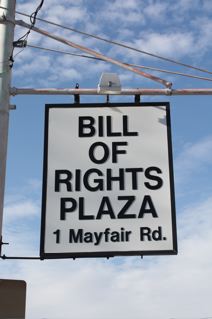
With Monday being Bill of Rights Day, it gives me a chance to write about a shopping plaza. Yeah, I know, that isn’t really the first thing to jump to your mind when discussing our rights. But as you can see from my photo, this particular shopping strip is called Bill of Rights Plaza, and it’s a couple miles from my home.
As it happens, Westchester County, just north of NYC for you out-of-towners, played a pretty big part in the creation of freedom of the press. It started with an election in 1733 on the village green in front of St. Paul’s Church in Eastchester. It seems that some folks wanted to vote, and others tried to stop them. Yes, I know that some things haven’t changed.
John Peter Zenger wrote about those voting irregularities, and in doing so was critical of the colonial governor. But since criticizing the British crown or its colonial puppets was not something to be tolerated, he was promptly arrested and put on trial for seditious libel. The truth of his writings was irrelevant under the law of seditious libel. To help insure a guilty verdict, the governor picked the judges.
Zenger’s defense — and the reason I write about it 275 years later — was novel; instead of contesting whether he he was guilty of the crime, he contested the law itself. Since what he wrote was true, he argued, he couldn’t be guilty of libel. The jury was asked to disregard the law, a concept we now call jury nullification. And the jury found Zenger not guilty.
From this one trial was born a concept that every member of the press (and every blogger, whether you think you are press or not) cherishes, for it now forms part of the First Amendment:
Congress shall make no law respecting an establishment of religion, or prohibiting the free exercise thereof; or abridging the freedom of speech, or of the press; or the right of the people peaceably to assemble, and to petition the Government for a redress of grievances.
Whether our nation’s founders thought it would be a good idea to name a shopping plaza after the Bill of Rights is another story. But if it makes a child or two ask their parents about that sign, then it seems to be worth it.
Updated:
Marc Randazza at the Legal Satyricon has put up a sensational Blawg Review #190, dedicated to the Bill of Rights. He’s got commentary from around the legal blogosphere on all ten.
See also:
- The Right to Defend (Greenfield @ Simple Justice, 4/23/08)
- The Rare Ruby-Throated Jury Nullification (Reed @ Deliberations, 2/26/07)
Links to this post:
it’s bill of rights day
as blawg review’s righteous editor reminded us a few days ago, president bush has declared today to be bill of rights day. you’ll find the text of the bill of rights — the first ten amendments to the us constitution — at the foot of …posted by David Giacalone @ December 15, 2008 12:57 PM
blawg review #190 – bill of rights day
billofrightsplaza-779503 the carnival of law bloggers has honored us with the privilege of hosting blawg review #190. we decided that since it was a carnival, we would just hold a freak show — no links to other blawgs, just pictures of …posted by marcorandazza @ December 15, 2008 7:29 AM
I posted about nullification not to long ago in the context of State Senator Vince Fumo’s fraud trial:
http://is.gd/bDIx
Without overloading your comments with the whole post, here’s a portion of it:
…
Juries tracing back to ancient times have, as they felt the circumstances warranted, exercised lenity against certain defendants by finding them guilty of fewer crimes than the evidence proved or handing out lesser sentences. But the supposed “right” to jury nullification was never truly recognized by English or American courts, and in 1895 the United States Supreme Court specifically prohibited the practice by upholding a trial judge’s instructions to a jury that, even if the jury believed a defendant on trial for murder deserved lenity and should be convicted only of manslaughter, that the jury had an obligation to convict that defendant of murder if the evidence established murder. Sparf v. United States, 156 U.S. 51 (1895).
Surprisingly, despite constant requests by criminal defense attorneys to argue nullification to juries continuing even to the present (and trial courts’ constant rulings prohibiting such arguments), the United States Supreme Court has not revisited the issue of jury nullification in nearly 100 years, despite an extensive overhaul of most of the legal ideology upon which the Sparf opinion was based.
But make no mistake: criminal defendants have no right to ask the jury for nullification, and defense lawyers who do so risk judicial sanction and even criminal conviction. United States v. Renfroe, 634 F. Supp. 1536 (W.D. Pa. 1986), aff’d without opinion by U.S. v. Renfroe, 806 F.2d 255 (3d Cir. Pa. 1986).
Yet, here we are today, with Fumo’s and Arnao’s attorneys effectively telling the jury – which is supposed to apply the law given to them by the court to the facts that the jury finds – that the judge has gotten the law all wrong. How can that be?
There are three answers to that question. First, the American legal system recognizes the inherent tension between the judge and the jury, permitting each to intrude upon the other’s domain (the jury intruding upon the law and the judge intruding upon the facts) where necessary to ensure justice is done. It is undeniable that, though a judge may remove a juror from the jury if the juror appears inclined to nullify the law, a judge also may not overturn a jury’s verdict of acquittal and re-try the defendant because of jury nullification. Gregg v. Georgia, 428 U.S. 153, 200 n.50 (1976) (“The suggestion that a jury’s verdict of acquittal could be overturned and a defendant retried would run afoul of the Sixth Amendment jury-trial guarantee and the Double Jeopardy Clause of the Fifth Amendment.”). These two principles cannot be reconciled. Their presence together represents a delicate balance necessary for a society in which justice is dispensed by the people, not the government, but in a fair and consistent manner across all trials.
…
# posted by Anonymous Max Kennerly : December 14, 2008 1:16 PM
As you enter Eastchester, the signs say “Home of the Bill of Rights.” This strikes me as peculiar since isn’t every community its “Home”? The older signs, I think, said “Birthplace of the Bill of Rights,” but that perhaps did not fit, sizewise.
You should note, however, that the trial was where the town hall. St. Paul’s is in Mount Vernon, it was in Eastchester until Mount Vernon was carved out of it in 1853.
# posted by Anonymous Joe Garland : December 14, 2008 8:30 PM
Joe:
Any idea if there is a sign or plaque of any kind at St. Paul’s to mark its unintended role in helping to create part of the First Amendment?
# posted by Blogger Eric Turkewitz : December 14, 2008 9:42 PM
Pingback: Bill of Rights Day – New York Personal Injury Law Blog
Pingback: This is Fair and Balanced. The Others Are Not « Out Of My Mind