New York’s 2007 lawyer advertising rules will be before the Second Circuit today (NYLJ: 2nd Circuit to Hear Arguments on Lawyer Ad Restrictions). In 2007, many of the restrictions had been struck down by a federal judge in Alexander & Catalano v. Cahill, though one particular restriction — the 30-day anti-solicitation rule — was upheld. (Decision and briefs here)
This posting discusses how the anti-solicitation rule can be circumvented and why it causes First Amendment problems in certain circumstances due to the breadth of its definition of solicitation. Indeed, under the rules, this very posting could qualify as an ethical violation as I use the US Airways Flight 1549 splash landing in the Hudson River as a case example on how the solicitations can occur. In fact, the ethics rule is so full of holes that it would sink in a true disaster.
An Internet savvy lawyer may try to beat the rules by making agreements with legal marketers from outside New York. I refer to the work-arounds as Ethics Laundering, for the reasons that follow. If New York wants its anti-solicitation rules to have any real effect, it will have to more fully appreciate how the Internet has altered the field of attorney marketing, how the ethics rule might be laundered, how they may violate the First Amendment, and deal with it appropriately.
By way of background, the 30-day rule came into being in the wake of the 2003 Staten Island Ferry disaster that killed 11 people. While rescue efforts were still underway, lawyers raced to the Staten Island Advance to place ads in the paper before the afternoon deadline for the next day’s paper. It was not the personal injury bar’s most shining moment.
The new anti-solicitation rules, which cover more than mass disasters but that seems to be where the real problem lies for online solicitation, went into effect on February 1, 2007 after a period of comment. Here’s the text:
DR 7-111 (22 NYCRR 1200.41-a) Communication After Incidents Involving Personal Injury or Wrongful Death
(a) In the event of an incident involving potential claims for personal injury or wrongful death, no unsolicited communication shall be made to an individual injured in the incident or to a family member or legal representative of such an individual, by a lawyer or law firm, or by any associate, agent, employee or other representative of a lawyer or law firm, seeking to represent the injured individual or legal representative thereof in potential litigation or in a proceeding arising out of the incident before the 30th day after the date of the incident, unless a filing must be made within 30 days of the incident as a legal prerequisite to the particular claim, in which case no unsolicited communication shall be made before the 15th day after the date of the incident.
The easiest place to start analysis of how the rule works is with direct solicitation, and then work through several examples of the more troublesome indirect solicitation that serve to launder the ethics involved. While direct solicitation has, in the past, generally dealt with direct mail, this positing will deal solely with Internet related marketing.
Bear in mind that, because no lives were lost on the US Airways crash, and because a flock of birds seems to be the leading cause, we were not swamped with ads. Thus, this piece is written in advance of the full implementation of the rule, while the matter is pending in the Second Circuit, with the hope that the rule can be modified to take these devices into account.
First, direct solicitation can take place with simple Google AdWords. Those are the ubiquitous ads you see on top of the natural search results or in the right hand side bar when you Google “personal injury lawyer” or most any other service or product known to the human race. People and companies, working through Google, submit words or phrases that will trigger the ad. Those keywords don’t have to be part of the ad. For instance, a generic personal injury ad may run, but there may be hundreds of keywords that trigger it regarding medical malpractice, drug interactions, car or labor law accidents, etc. Where you land in the advertising results, be it in the first position on the first page or buried on page three, depends on how much you bid for the particular keywords you used.
So in the wake of the Hudson River crash, I searched around and found one firm that seemed to blatantly violate the ethics rule, according to my reading, by actually using these words in addition to the firm’s website link:
USAirways Crash Victim?
Helping Victims of Flight 1549
[Law firm link redacted]
But not all such solicitation is so obvious. How about the firm that uses the keywords “Hudson River” and “1549” to get placement of their aviation law firm in the Google results, but doesn’t mention the particular accident in the ad that the public sees? In this manner, law firm marketers get their ads placed under the noses of searching victims in violation of the rule, but without making it obvious. Catching these people requires someone actively looking for the violations by ignoring obvious keywords (aviation, airline, attorney, etc.), and then subpoenaing Google to get the list of keywords from the lawyer’s account.
Another trick is to simply modify the website of a firm and lard it with keywords for Google to index. Is that a solicitation in violation of DR-711? According to Ethical Consideration (EC) 2-18 of the rules:
A “solicitation” means any advertisement:
a) which is initiated by a lawyer or law firm (as opposed to a communication made in response to an inquiry initiated by a potential client);
b) with a primary purpose of persuading recipients to retain the lawyer or law firm (as opposed to providing educational information about the law) (see EC 2-6(c));
c) which has as a significant motive for the lawyer to make money (as opposed to a public interest lawyer offering pro bono services); and
d) which is directed to or targeted at a specific recipient or group of recipients, or their family members or legal representatives. (emphasis added)
Does the act of adding the text of the accident to an existing website mean that it is an ad “directed to or targeted” at the victim group? It would seem so, since the definition of “directed to or targeted” means that it is referring to the target group. The definitional text for the phrase is under Ethical Consideration (EC) 2-19(c):
“…an advertisement in a public medium such as newspapers, television, billboards, web sites or the like is a solicitation if it makes reference to a specific person or group of people whose legal needs arise out of a specific incident to which the advertisement explicitly refers.”
If all one needs to do is “make reference” to an accident, then it seems to create a troubling constitutional issue. What is to stop a firm from putting an “in the news” on its web site that deals with Flight 1549 (or a big construction accident or other event) that just so happens to tickle the magic Googlebots with the “correct” keywords for the victims to find them? The result, it seems, would be a clear First Amendment battle.
The same issue may exist for a blogger who writes about local accidents in the hope that someone will Google the accident and find the firm (see: Attorney Solicitation 2.0 — Is it Ethical?). While this can be a very crude and obvious device, it nevertheless also runs into the same First Amendment issue. Even a subtle mention of the accident — I did make reference to US Airways flight 1549 in this article didn’t I? — might trigger the rule in the eyes of some. There are a million shades of gray between the obvious and the subtle in determining which blogger is trying to add to the discussion of an issue and which one is hustling business.
The solution here may be well beyond anything that the courts can do by way of ethical rules due to constitutional constraints. It thus becomes up to writers to speak up when they see these things happen in the hope that public humiliation will stop the conduct, as the implied threat of destruction to one’s Google reputation can be a powerful incentive in the digital age. While the briefs and lower court opinion in today’s case didn’t go into the level of detail I have here, one can clearly see how the rule may not be workable.
Now moving on to the more secretive and, I think, insidious types of advertising: The attorney search services. These are web sites that are not affiliated with any one law firm, with charming names like WhoCanISue and SueEasy, that run ads trying to attract potential clients. Leads are then distributed by the company to attorneys, whose names do not appear anywhere on the website. There are dozens of these companies out there, and I regularly get calls and emails from them. One called PleaseGetMeAnAttorney, for example, sent me an unsolicited email that offered to provide leads at “$3,995.00 per territory, per month.”
These attorney search services are particularly diabolical from the ethics standpoint. They are unlikely to have their home in New York and may not even be run by attorneys. They therefore will fall well outside any jurisdiction that New York courts may have to discipline for ethics violations. They can advertise free from any constraints and may skate right off the edges of the ethical pond. But what of the attorneys that have signed up with them? They, no doubt, turn a blind eye to the devices used by the companies and will cry ignorance if confronted.
And very similar to the attorney search services are the “national” law firms that are little more than referral mills. They seek to sign up clients the same way the attorney search services do, but instead of getting paid a flat fee for leads they will receive a piece of the legal fee if the matter successful, as part of a joint venture with local counsel.
How, exactly, is New York going to stop these outside lawyers and search services from soliciting in New York and laundering the ethical rules that local counsel must abide by? Well these outsiders are theoretically subject to New York’s anti-solicitation rule under EC-221:
Extra-Territorial Application of Solicitation Rules
EC 2-21 All of the special solicitation rules, including the special 30 day (or 15 day) rule, apply to solicitations directed to recipients in New York, whether made by a lawyer admitted in New York or a lawyer admitted in any another jurisdiction.
But if the Second Circuit upholds the constitutionality of the 30-day rule, how will enforcement actually take place for the attorney that is not admitted in New York? And has a New York lawyer committed a violation by accepting the case from the outsider that violated the rules? And how is the New York lawyer supposed to know that the out-of-state referring lawyer or search company violated the ethics rules?
I suggest that the Office of Court Administration use the Retainer Statements to catch the ethical launderers. Those statements, that must be filed in every personal injury case taken on contingency, require the retained lawyer to specify who the referring sources are, be they attorneys or not. In the event of a tragedy that triggers the rule, OCA must anticipate the problem and do an immediate web search to see who is violating the rules, then cross-check that list against the incoming Retainer Statements. The rules must be clear now that, if the referring lawyer or service violated the anti-solicitation rule, then the matter will be forwarded to the disciplinary committee.
There should be little doubt that search services, as well as non-New York Lawyers that solicit here for the purpose of entering into joint ventures with local counsel, are agents of the law firms and that local counsel must therefore be accountable for the acts of these agents. For only by forcing accountability on local counsel will they, in turn, demand ethical conduct from the search company or New York outsiders. If local counsel understands that they may lose their fee after having done substantial work, they will more than think twice about whom they do business with.
This is not, by any means, a plea to get rid of the 30-day anti-solicitation rule altogether. Solicitation is ugly and a blight on the profession. Rather, it is a plea to clean the rule up, either before or after the Second Circuit decides, and make it clear that attempts to circumvent the rule by laundering the ethical issues will not be tolerated. And that is something that should be done now, and not after a real disaster.
——————————
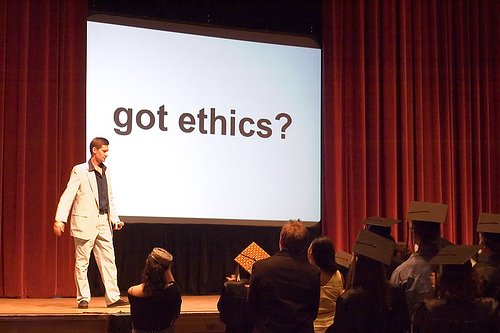
Photo credit: Jordan Husney (via Flickr)
——-
Update 1/23/09, After the Second Circuit Argument: 2nd Circuit Skeptical Over Restoration of Rules Curbing Content of Ads (NYLJ via Law.com)
Links to this post:
I’ll Take Turkewitz on Ethics Over Jack Marshall Any Day of the Week
Over at his sparsely populated and impossible to navigate blog Ethics Alarm, American University Washington College of Law adjunct ethics professor Jack Marshall accuses wildly popular New York Personal Injury Law Attorney Law blogger …posted by Carolyn Elefant @ April 05, 2010 12:36 PM
why the devil’s in the details of ethics rules when you start a …
i’d love to be able to share the specifics about how to start and run a law firm for every jurisdiction in the country. in part, that was the reason behind myshingle’s the bars, reviewed which summarizes the benefits for solos and small …posted by loce@his.com (Carolyn Elefant) @ March 17, 2009 10:41 PM
february 3 roundup
lawyer charged with particularly awful pattern of thefts from disabled/incapacitated persons [nytimes, steven rondos]; “buy american” provisions in stimulus bill could start trade war [postrel]. parting blow to america’s taste buds: …posted by Walter Olson @ February 03, 2009 1:11 PM
mortimer, morden, and miracles
a few “quickies” that took too long to write this saturday morning afternoon: thank you, john mortimer, for creating rumpole: as today’s new york times reports, “john mortimer, barrister and writer who created rumpole, dies at 85” (jan. …posted by David Giacalone @ January 17, 2009 1:25 PM
There is no question that state bar ethics rules serve an important function in protecting the public. Unfortunately, like so many other areas or professional responsibility, the various state bar ethics opinions are far-too arcane and, as stated above, out of touch with the world search engine marketing. There is a lot of arbitrary hair-splitting going on out there. In the end, lawyers, like everyone else, have a 1st amendment right to commercial speech. Let’s embrace this fact and tailor rules that actually benefit the public instead of insulating the old-boys network.
Great article. I did know the extent of this rule.
Hi Eric- excellent and timely post. Keep up the good work.
Gerry Oginski
Well, I wouldn’t say that “solicitation (as the Bar uses it to be synonymous with any advertising) is ugly and a blight on the profession”… UNETHICAL solicitation is. So I agree with every other point you make. The more we clean up the language, the less loopholes, and quite frankly, the easier it is for us to market legal services properly and create an even marketing field.
Advertising, self-promotion, and even targeted solicitation can be done ethically according to the codes, and with dignity – according to our own morays – and with respect to potential (and current) clientele.
We will always have unscrupulous and “shady-clever” lawyers (and marketeers) in this field. Our job is to rise above it, all the while showcasing our expertise and distinctiveness.
~ Vikram Rajan
PracticeMarketingAdvisors.com
Vik:
While all soliciting is advertising, not all advertising is soliciting.
See EC 2-17 at page 20 of these rules:
http://tinyurl.com/coh48n
Good post. Like you, and many attorneys, I too feel that the bar associations are crossing the line with their attempts to govern the “ethics” of attorneys.
While the rules are clearly meant to regulate personal injury attys and ads, they unnecessarily affect attorneys like us – who practice construction law and 0 peresonal injury: http://www.wolfelaw.com.
In fact, we have filed suit in Louisiana to challenge the new advertising rules in that state. http://www.protectspeech.com.
Lawyers will argue anything. This article just proves what a slimy lot they are. They can’t even write rules to govern themselves that they can all understand and stick to. Just ban all advertising for lawyers.
Pingback: FuneralHomes.Com Digs Down Deep For Personal Injury Lawyers – New York Personal Injury Law Blog
Pingback: North Carolina to Allow Non-Lawyers to Buy Interest in Firms? (Lousy Idea) – New York Personal Injury Law Blog
Pingback: Lawyer Solicitation: Penn State Sex Abuse Edition – New York Personal Injury Law Blog